Urban Military Strike: Reading a Multilevel Operation
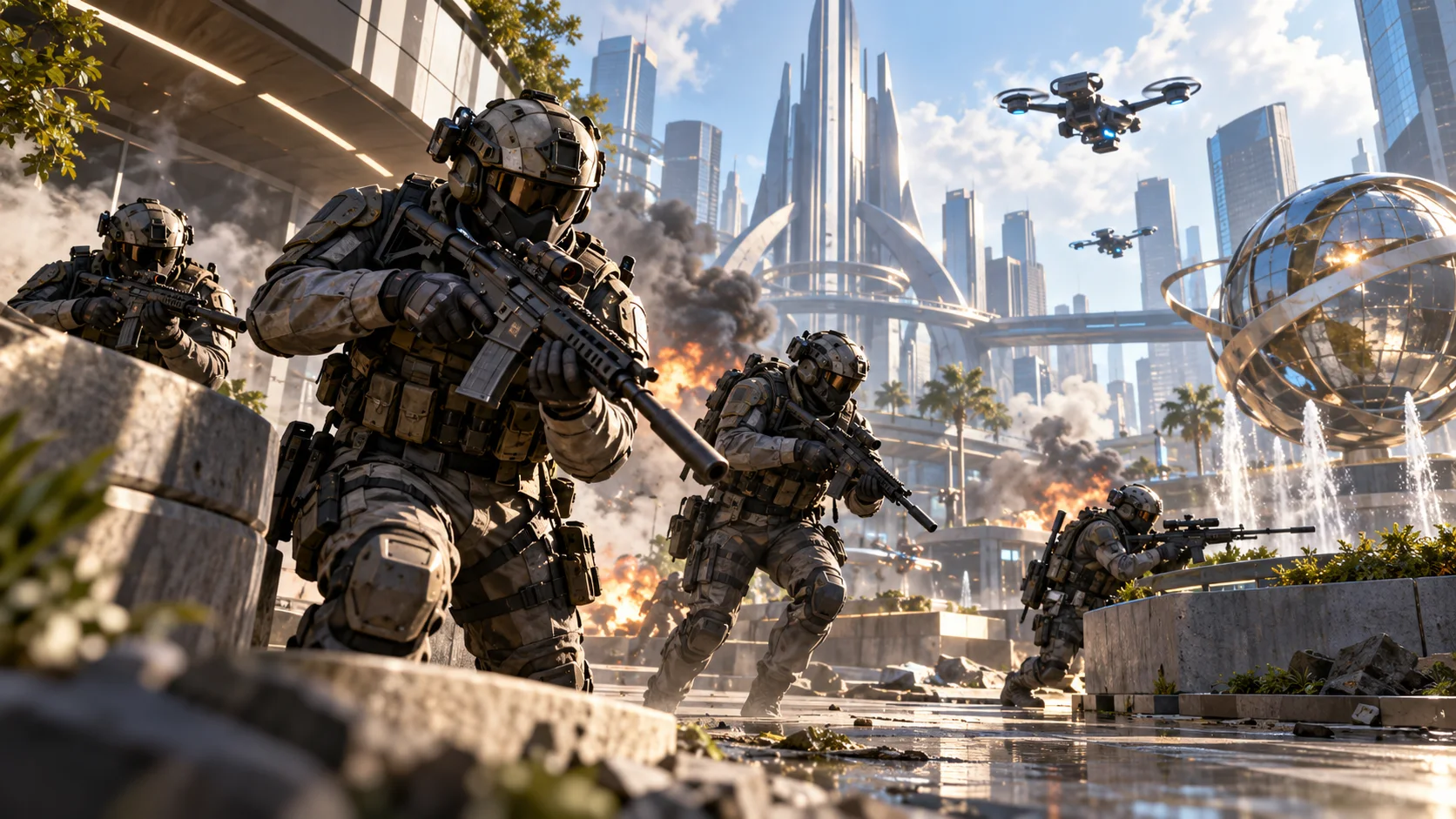
Urban Military Strike frames its action as a sequence of tactical operations inside close-quarters urban spaces. The confirmed description names realistic weapon ballistics, coordinated thermal breaches, shifting objectives, squad communication, strategic positioning, and multi-level battlefields. Those details make the city more than scenery: rooms, corridors, entrances, and changes in elevation become information that must be read before a decision is made. This visual essay looks at how the known elements can communicate pressure and direction without inventing weapons, missions, maps, or controls that the source does not establish.
An urban battlefield is built from layers
A multi-level environment asks the player to read more than a single horizontal route. Doors can suggest transitions, stairs can connect one height to another, and windows or openings can expose positions across separate parts of the scene. The exact architecture belongs to the running game, but the supplied premise confirms that elevation is part of the tactical setting. Clear boundaries therefore matter. A wall, floor edge, or doorway should remain recognizable even when combat effects occupy the frame.
Close-quarters spaces create a different visual rhythm from open ground. The next threat may be near, partly hidden, or connected to another room. That makes a quick scan of corners and entrances useful before movement. It does not prove a particular enemy system; it simply follows the confirmed emphasis on positioning and split-second decisions.
Thermal breaches create a moment of preparation
The source specifically mentions coordinating thermal breaches with a squad. A breach can divide an operation into two readable moments: preparation outside a barrier and action after the route opens. The screen needs enough feedback to show when the team is ready, where attention is focused, and what changed after the breach. Exact timing and input remain matters for the live instructions.
Squad communication is also listed, but the description does not identify voice chat, command wheels, or other interface systems. It is safer to understand communication through the operation itself: shared positioning, synchronized movement, and visible responses from squad members. Any more specific feature must be confirmed in the active version.
Objectives can change the meaning of the same room
Shifting objectives imply that a route is not understood once and then forgotten. A space used for entry may later become a defensive position or a connection to another level. Objective text and markers should therefore remain distinct from decorative military graphics. The player needs to know what is currently required, not merely what the environment looks like.
This structure also makes observation part of the pace. A decision that was appropriate before an update may no longer fit after the objective changes. The useful response is to read the current prompt, compare it with the visible routes, and then choose a position. The source does not provide a mission order, score system, or reward loop, so none is assumed here.
Visual notes before entering
- Separate accessible routes from background architecture.
- Use elevation cues to understand the multi-level layout.
- Watch the live objective whenever the operation changes.
- Read squad movement without assuming an undocumented communication tool.
- Follow the on-screen controls for aiming, movement, and breach actions.
Open the operation
Visit Urban Military Strike for the current controls and objective prompts. The Arcade Games category provides another route through action-focused titles on the site. The public game page remains the authority for every input and for details that are not included in the supplied description.
A city defined by decisions
The strongest confirmed idea in Urban Military Strike is the connection between place and choice. Close rooms shorten reaction time, multiple levels expand the directions that need attention, a breach changes access, and a shifting objective changes priority. Realistic ballistics are named, but no numerical model is available, so the important editorial point is narrower: position and timing matter within the presented operation.
When these elements are visually separated, the battlefield can feel intense without becoming unreadable. Architecture establishes routes, squad behavior gives context, and objective feedback identifies the immediate task. That combination is enough to describe the game accurately while leaving unverified equipment, enemies, and mission details to the running version.