Snow Rider Neo: How a Downhill Run Changes Its Reading
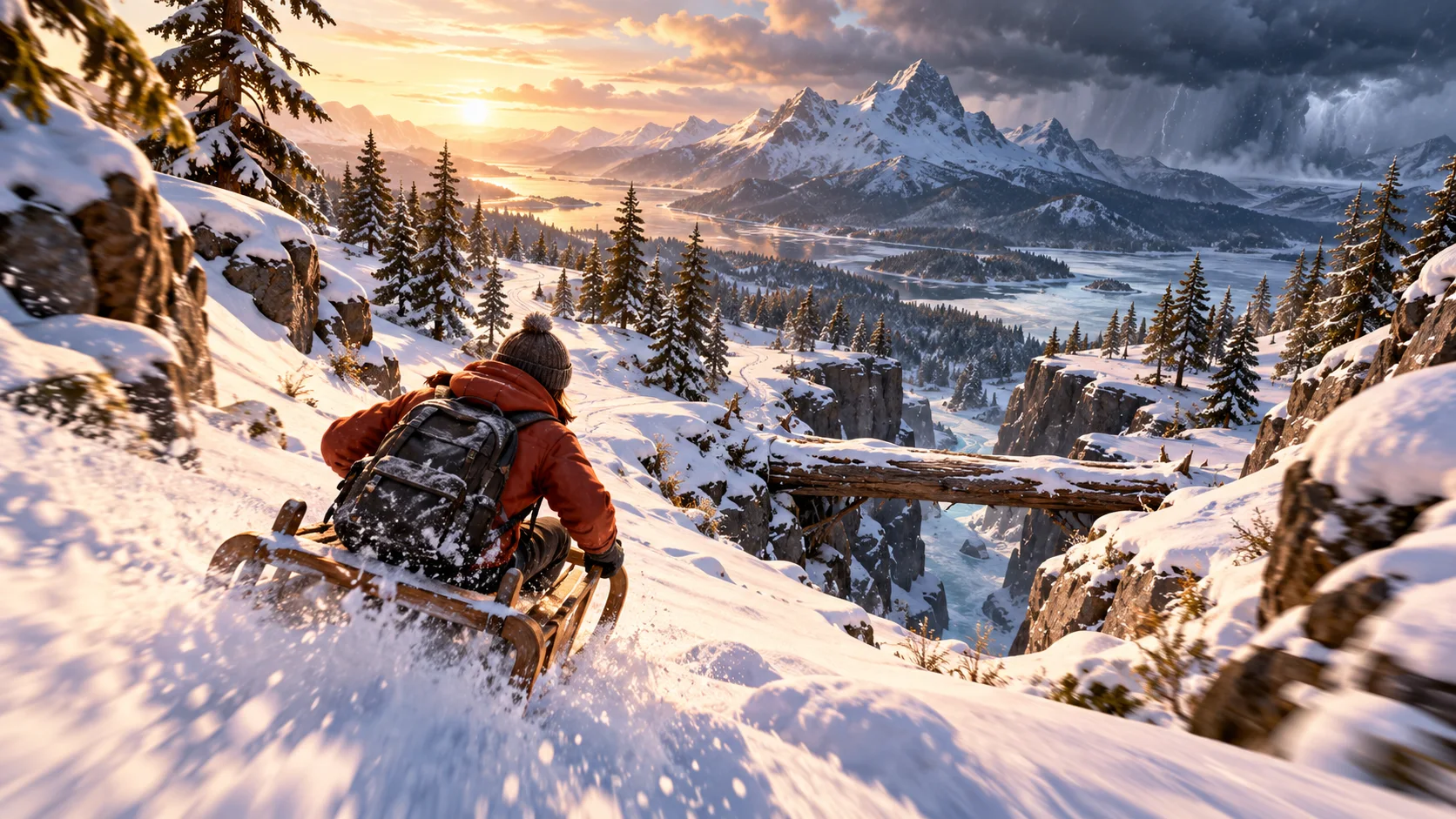
A downhill route has a useful contradiction: the direction is obvious, but the next safe line is not. Snow Rider Neo builds its sledding theme around that distinction. The supplied game description identifies snowy forests, mountain slopes, trees, rocks, snowmen, rolling snowballs, logs, gaps, ramps, changing weather, and a distance record. Taken together, these details explain why the scene cannot be read as a static picture. The slope carries the sled forward while each obstacle asks for a fresh judgment of space.
Foreground Decisions, Distant Warnings
When a tree or rock is close, its position is the immediate concern. Farther downhill, a log, gap, or ramp can be treated as an early warning. This difference between the foreground and the distance is the core visual problem of an endless run: looking only at what is nearest may leave too little time to prepare for what comes next. The game page should be consulted for the exact movement response; the useful reading principle is to keep both zones in view.
The variety of obstacles also matters. A stationary tree occupies space in a different way from a rolling snowball. A gap interrupts the surface, whereas a ramp changes its shape. Those are not interchangeable hazards, and the description does not require them to be treated as one generic category. Their silhouettes and relative motion provide different kinds of information.
Weather Alters the Same Landscape
Clear conditions can give way to snowfall or a blizzard. The route is still a snowy descent, but visibility and contrast can change. A dark tree against bright snow is easier to separate than a pale shape against a field of moving flakes. This is an editorial observation about the described setting, not a promise about a particular difficulty curve or weather schedule.
Mountain scenery often invites a long view. Here that view serves a practical purpose: it helps establish the slope, the line of travel, and the next interruption in the ground. The forest supplies repeated vertical markers, while snow and open sky give those markers room to stand apart.
Weather can also change which parts of a scene attract attention. In clear conditions, the eye may travel far down the slope and use the treeline as a broad guide. During heavier snowfall, nearby silhouettes and the immediate edge of the route may become more prominent. This shift does not require a new rule or a different control scheme. It changes the visual evidence available at a given moment. The downhill course remains the same kind of place, but the player's reading distance can feel shorter.
Choice Without a Fixed Finish
The supplied description calls Snow Rider Neo an endless sledding game and mentions a best-distance measure. That makes the run less like a journey to a named endpoint and more like a continuing sequence of local choices. The description also identifies three sleds with different handling and gifts that unlock paint finishes. Handling concerns how a run feels; paint concerns appearance. Keeping those two kinds of choice separate avoids treating every collectible as a performance advantage.
Visual Notes
- Trees and rocks give the course solid boundaries.
- Logs and gaps change how the ground can be approached.
- Ramps introduce a different shape to the downhill path.
- Rolling snowballs add movement beyond the sled itself.
- Snowfall can change the readability of familiar forms.
Continue on OviGames
Open Snow Rider Neo to see the public game page, browse Racing Games for related driving and movement themes, or return to the OviGames homepage.
Closing Observation
The most interesting part of a descent is not speed alone. It is the repeated shift from seeing an object to deciding what that object means for the next few moments. Snow Rider Neo gives that shift a winter landscape, varied obstacles, and weather that can alter the view. The lasting visual idea is simple: the slope stays constant, but the reading of it never does.