Police Car Chase Prison Escape Game: A City Pursuit Visual Essay
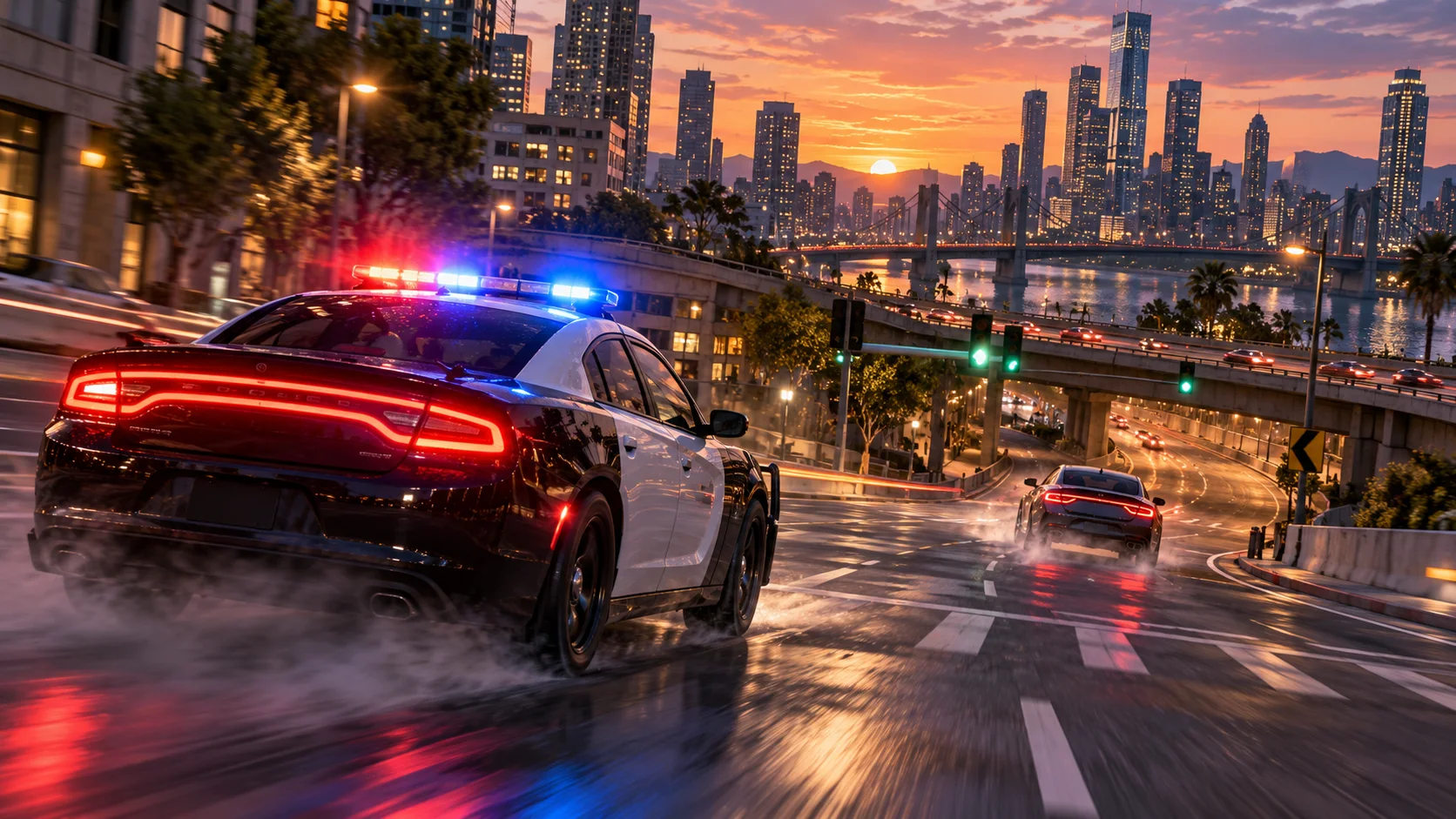
Police Car Chase Prison Escape Game places a police officer behind the wheel during pursuits connected with prison escapees and the protection of a busy city. The confirmed description emphasizes police vehicles, driving, chasing, apprehension, action-focused missions, and a three-dimensional urban setting. Those facts establish a clear visual problem: the city must communicate route, danger, and direction while the vehicle remains easy to locate inside a fast-moving scene. This essay considers that relationship without inventing vehicle models, mission counts, criminal behavior, control layouts, or reward systems that the available information does not establish.
The city is both setting and route
An urban environment contains many competing shapes. Streets, buildings, parked objects, moving vehicles, and intersections can all occupy attention at once. During a pursuit, however, the useful route must remain readable. Road edges and openings need enough visual separation for the player to understand where the police vehicle can continue and where the city becomes a boundary.
The supplied description presents the city as bustling, but it does not identify a map, district system, traffic model, or named location. The strongest factual reading is therefore structural. Streets connect one part of the action to another, buildings give the pursuit a sense of scale, and visible obstacles shape the next driving decision. Details beyond that should come from the active game.
A police vehicle carries the focus
The player is described as controlling police vehicles while pursuing criminals. In visual terms, the active vehicle must stay distinct from the surrounding traffic and architecture. Its outline, position, and direction should be recognizable even when several objects occupy the frame. The description mentions powerful engines and advanced features in broad language, but it does not define a specific capability, so none is assumed here.
Driving skill and strategic thinking are both named. That pairing suggests that speed alone is not the complete subject. A route can be reconsidered at an intersection, and the distance between the police vehicle and its target can influence the next choice. The live interface remains the authority for steering, braking, camera behavior, and any action connected with apprehension.
The chase needs a visual hierarchy
A chase works when the player can distinguish the target, the current road, and immediate hazards. These elements do not need identical visual emphasis. The target provides direction, the road provides possibility, and nearby obstacles define risk. If decorative city detail becomes louder than all three, urgency can turn into confusion rather than meaningful pressure.
The prison-escape premise gives the pursuit a reason, but it does not confirm a separate prison interior, an escape sequence, or a narrative order. The title and description support police action against escapees within the wider city. It is accurate to discuss that pursuit while leaving exact mission staging to the running version.
Visual notes from the pursuit
- Keep the active police vehicle distinct from ordinary city detail.
- Read intersections as choices rather than background decoration.
- Use visible road boundaries to anticipate the next turn.
- Follow current mission prompts instead of assuming a fixed pursuit order.
- Confirm every control and vehicle action on the live game screen.
Open the city route
Visit Police Car Chase Prison Escape Game to see its current pursuit, objectives, and controls. The Adventure Games category provides another route through games built around movement and active scenarios. These links identify the real game and its existing category without implying undocumented features.
A pursuit built from readable decisions
The central visual tension comes from motion inside a structured place. The police vehicle must keep moving, yet the city continually divides that movement into streets, corners, and intersections. A clear presentation allows urgency to coexist with observation. The player can see the immediate direction, compare available space, and respond to the objective shown by the game.
Police Car Chase Prison Escape Game can therefore be described accurately through three confirmed layers: the officer's role, the vehicle pursuit, and the urban environment. Each layer supports the others. The role supplies purpose, the vehicle supplies motion, and the city supplies the route. That is enough for a focused visual essay without adding invented equipment, missions, characters, or technical guarantees.