Obby Climb and Jump Tower: Reading a Vertical Route
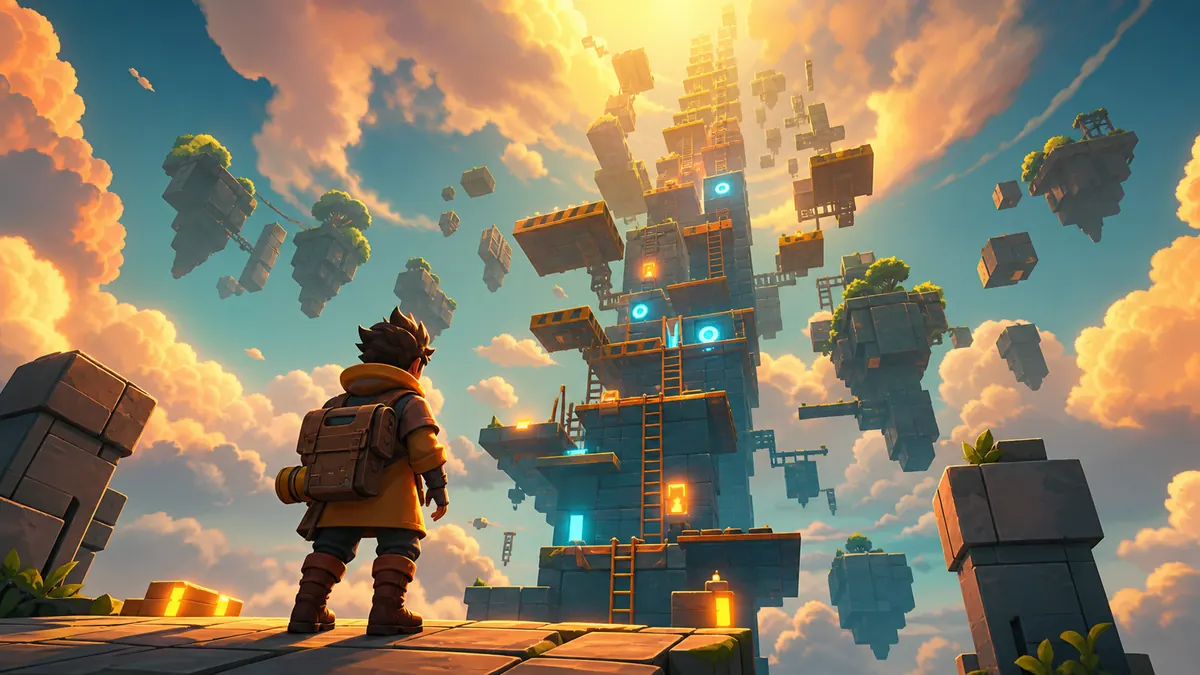
Obby Climb and Jump Tower turns height into a visual language. Rather than repeating the game description, this article looks at how platforms, ladders, gaps, and distant markers can make a tall obstacle course understandable before the next movement begins.
Height Needs Visible Structure
A convincing tower is more than a stack of objects. Repeated platform widths create rhythm, while occasional wider resting areas divide the ascent into readable groups. When the next ledge remains visible, height feels challenging without becoming visually confusing.
Color Can Mark Progress
Warm checkpoint lights and cool structural surfaces separate important locations from the surrounding architecture. The contrast lets the eye identify possible destinations without filling the scene with labels. The original hero image is editorial artwork, not a screenshot.
Clouds Establish Scale
Soft cloud layers give the tower a clear sense of altitude. Their low detail prevents competition with the platforms, while the horizon offers a stable reference against the increasingly vertical construction.
Clues That Clarify the Route
- Ladders aligned with the platform above.
- Open space around safe landing areas.
- Consistent edges on repeated obstacles.
- Lighting that separates near and distant sections.
Explore the Game and Its Category
Obby Climb and Jump Tower opens on OviGames. It belongs to Adventure Games. More recent browser titles are available from the OviGames homepage.
Final Perspective
A vertical route works when every level communicates what comes next. Repetition provides order, color identifies key positions, and open sky preserves the feeling of height.
Extended Visual Essay
Within Obby Climb and Jump Tower, the idea of Height Needs Visible Structure deserves more than a quick glance. The value of this detail lies in the way it organizes attention without relying on promotional claims. The specific note “Consistent edges on repeated obstacles” supplies an article-based reference, so the discussion can develop from material already established rather than from an invented feature. Seen in this context, the detail supports the article’s argument without adding unverified mechanics.
A measured reading of Obby Climb and Jump Tower begins with the relationship described as Color Can Mark Progress. This observation connects the larger scene with the smaller reference points already identified in the article. The specific note “Lighting that separates near and distant sections” supplies an article-based reference, so the discussion can develop from material already established rather than from an invented feature. Seen in this context, the detail supports the article’s argument without adding unverified mechanics.
The visual argument around Obby Climb and Jump Tower becomes clearer when Clouds Establish Scale is considered at a slower pace. The composition can be read as a sequence of choices about emphasis, distance, and balance. The specific note “Ladders aligned with the platform above” supplies an article-based reference, so the discussion can develop from material already established rather than from an invented feature. Seen in this context, the detail supports the article’s argument without adding unverified mechanics.
Within Obby Climb and Jump Tower, the idea of Clues That Clarify the Route deserves more than a quick glance. The value of this detail lies in the way it organizes attention without relying on promotional claims. The specific note “Open space around safe landing areas” supplies an article-based reference, so the discussion can develop from material already established rather than from an invented feature. Seen in this context, the detail supports the article’s argument without adding unverified mechanics.
A measured reading of Obby Climb and Jump Tower begins with the relationship described as Explore the Game and Its Category. This observation connects the larger scene with the smaller reference points already identified in the article. The specific note “Consistent edges on repeated obstacles” supplies an article-based reference, so the discussion can develop from material already established rather than from an invented feature. Seen in this context, the detail supports the article’s argument without adding unverified mechanics.
The visual argument around Obby Climb and Jump Tower becomes clearer when Final Perspective is considered at a slower pace. The composition can be read as a sequence of choices about emphasis, distance, and balance. The specific note “Lighting that separates near and distant sections” supplies an article-based reference, so the discussion can develop from material already established rather than from an invented feature. Seen in this context, the detail supports the article’s argument without adding unverified mechanics.
Within Obby Climb and Jump Tower, the idea of Height Needs Visible Structure deserves more than a quick glance. The value of this detail lies in the way it organizes attention without relying on promotional claims. The specific note “Ladders aligned with the platform above” supplies an article-based reference, so the discussion can develop from material already established rather than from an invented feature. Seen in this context, the detail supports the article’s argument without adding unverified mechanics.
A measured reading of Obby Climb and Jump Tower begins with the relationship described as Color Can Mark Progress. This observation connects the larger scene with the smaller reference points already identified in the article. The specific note “Open space around safe landing areas” supplies an article-based reference, so the discussion can develop from material already established rather than from an invented feature. Seen in this context, the detail supports the article’s argument without adding unverified mechanics.
The visual argument around Obby Climb and Jump Tower becomes clearer when Clouds Establish Scale is considered at a slower pace. The composition can be read as a sequence of choices about emphasis, distance, and balance. The specific note “Consistent edges on repeated obstacles” supplies an article-based reference, so the discussion can develop from material already established rather than from an invented feature. Seen in this context, the detail supports the article’s argument without adding unverified mechanics.