Mud Truck Simulator Game: Reading Mud, Ruts, and Traction
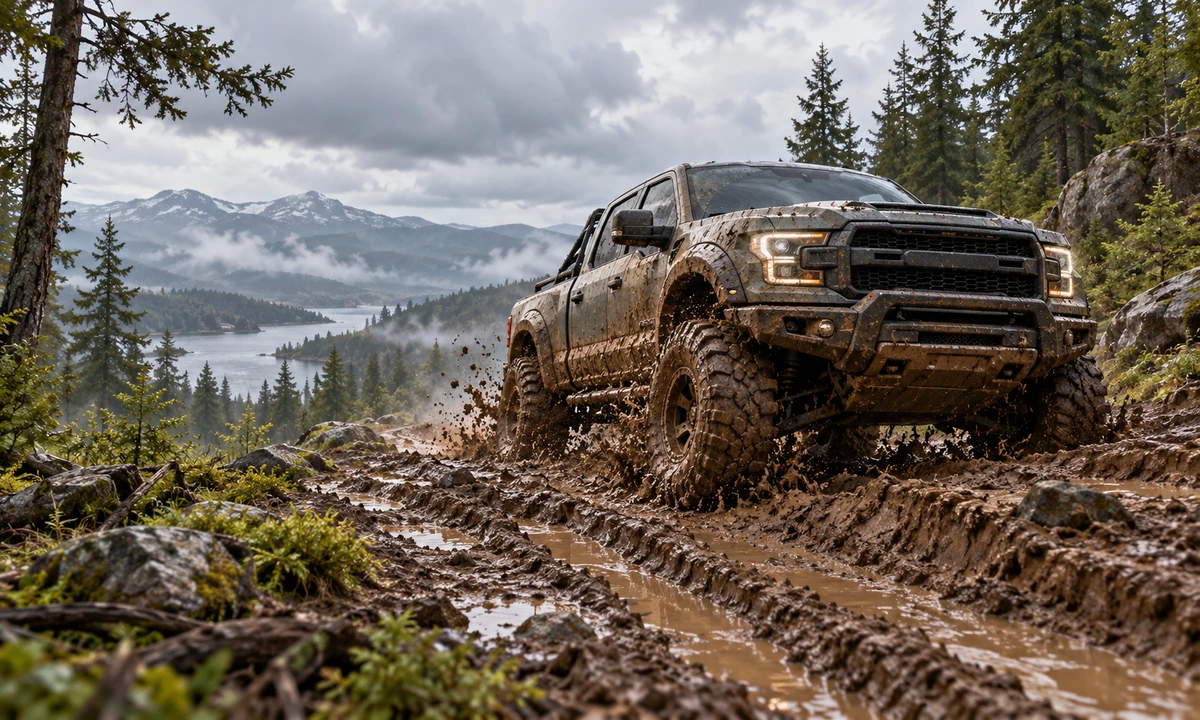
Mud Truck Simulator Game is an off-road driving title built around taking a truck across muddy, uneven terrain. Its central visual idea is easy to understand: the road itself becomes a changing surface rather than a clean strip between destinations. Tire grooves, soft ground, and rises in the trail make the landscape part of the driving problem. This essay looks at how those visible cues can help a player read a route, while leaving exact vehicle behavior and controls to the game’s live interface.
A road that records movement
A muddy trail can show where a vehicle has already passed. Parallel ruts create direction, while scattered patches of softer ground interrupt that pattern. The difference between a firm edge and a darker, churned section gives the eye something to compare before the next movement. In a driving game, this kind of surface detail is useful when it supports orientation instead of becoming decoration that hides the route.
The game’s title and supplier description establish mud driving and off-road terrain as the subject. They do not specify a particular truck model, weather system, damage model, or set of missions. Those details should not be assumed. The safest reading is the one the scene itself supports: a truck, a rough track, and the need to judge how the vehicle approaches uneven ground.
Weight and space in the composition
A large vehicle naturally becomes the visual anchor. Its body occupies more screen space than a rut or stone, so a clear silhouette helps separate the truck from the surrounding earth. The path then supplies scale: narrow edges and irregular marks make the vehicle feel heavy without requiring an exaggerated camera angle. If the horizon and nearby obstacles remain distinct, the player can read both the immediate surface and the direction beyond it.
There is also a useful contrast between broad forms and small detail. The truck gives the scene a stable shape; mud splashes and tire impressions add evidence of movement. Too many fine marks could flatten into visual noise, while a few deliberate tracks make the surface legible. That is a design observation about how an off-road scene can communicate, not a claim about a specific simulation feature.
Traction is a question of timing
Driving across an uneven route invites attention to pace. A steep patch, a narrow passage, or a deep rut can change how a player chooses to approach the next section. The game presents this as an off-road challenge, but no exact speed rule or vehicle response is asserted here. The controls and feedback shown during play are the reliable guide to acceleration, steering, and recovery.
That restraint matters because “simulation” in a title does not by itself establish how closely every physical response follows real-world driving. A careful article can discuss the relationship between visible terrain and player attention without promising authentic suspension, tire pressure, or engine behavior. The scene is interesting enough on its own: the route appears less predictable than a paved circuit, and the truck must be read against that roughness.
Visual notes
- Ruts can point along the route and reveal a previous line through the mud.
- Edges of the track help distinguish passable ground from the surrounding terrain.
- The truck’s silhouette supplies scale against the uneven surface.
- Small splashes and marks can imply motion when they remain visually secondary.
These notes describe cues to look for in the scene, not guaranteed obstacles or rules in every level. The active game remains the source for its current track and instructions.
Explore the route
Open Mud Truck Simulator Game on OviGames, browse more driving titles in Racing Games, or return to the OviGames homepage to find another browser game.
A surface that asks to be read
The appeal of an off-road scene comes from the exchange between vehicle and ground. The truck establishes weight, the ruts suggest direction, and the irregular trail gives each approach a little uncertainty. When those elements stay visually distinct, a muddy road becomes more than a background: it becomes the clearest way to understand what the player is navigating.