Monster SpaceShip Shooter: Space, Composition, and Visible Threats
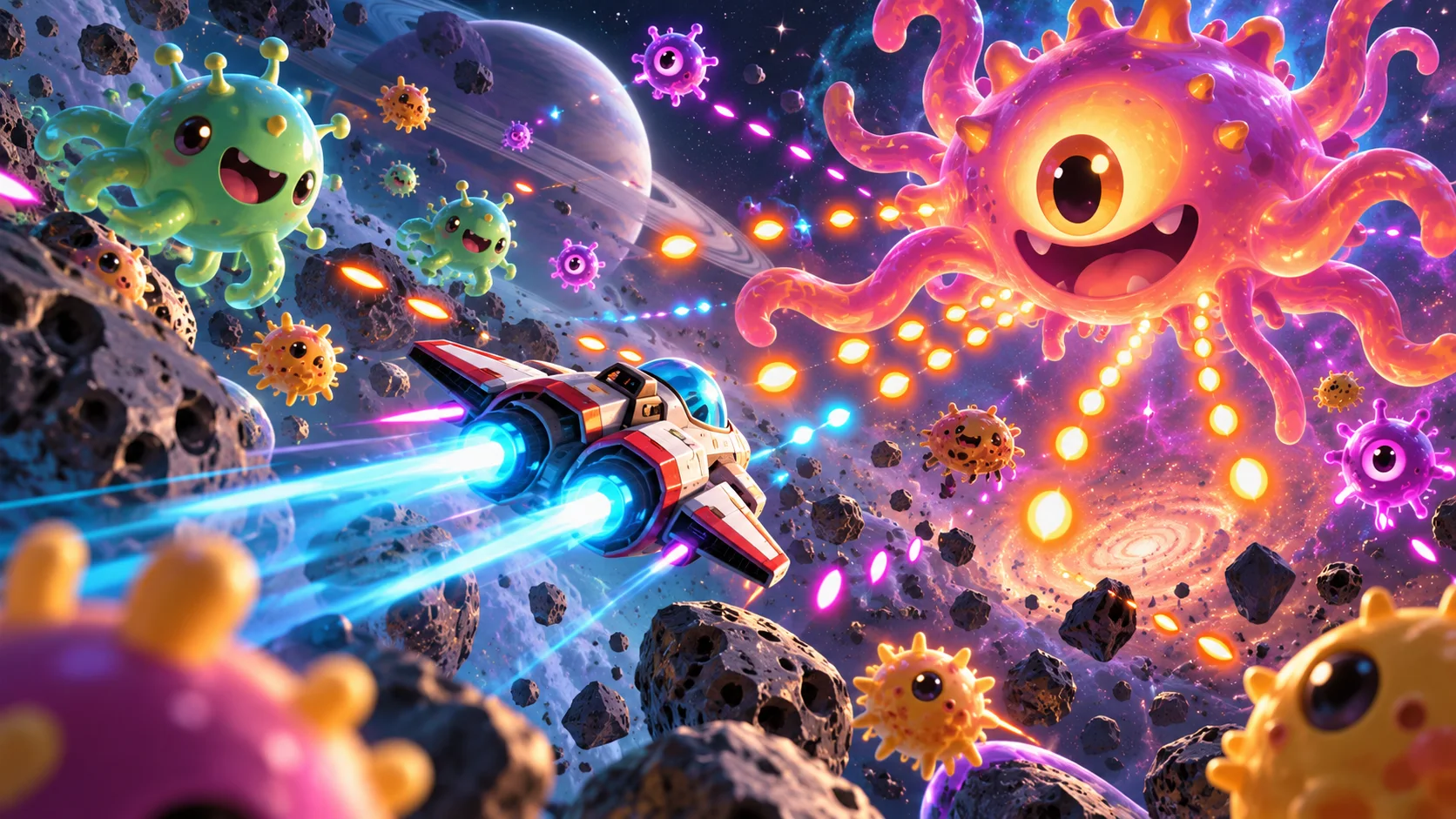
Monster SpaceShip Shooter places a small spacecraft against an open cosmic battlefield populated by strange creatures, projectiles, and environmental hazards. The premise is readable because the craft remains the visual anchor while movement around it supplies urgency. Empty space is not simply background; it gives every approaching object a direction, distance, and potential path toward the player.
The spacecraft as the fixed reference
In a scene filled with motion, the controlled ship provides the most useful point of comparison. Its position establishes where threats are coming from and how much room remains for an evasive response. Projectiles gain meaning through their relationship to the craft, not merely through color or animation. A distant object may be harmless for the moment, while a smaller nearby shape can demand immediate attention.
This hierarchy allows the eye to separate foreground danger from decorative cosmic material. Stars and distant forms create atmosphere, but the active objects use stronger contrast and clearer motion. The screen therefore communicates two layers at once: an imaginative space setting and a practical map of changing risks.
Movement creates temporary corridors
Open areas appear and disappear as enemies and shots cross the scene. Reading these gaps is more useful than following a single target for too long. A safe corridor is temporary, shaped by several trajectories at once. The best visual choice may be the region that preserves more than one possible exit rather than the shortest direct movement.
The public information identifies steering and firing at approaching threats as the central actions. Their relationship matters. Firing directs attention outward, while steering protects the ship’s position. When both happen together, the interface must keep the craft, incoming fire, and intended target distinct. Clear spacing supports that balance and prevents action from becoming visually arbitrary.
Contrast and scale in the battlefield
Monster shapes give opponents an immediate identity without requiring a complicated narrative. Differences in silhouette help distinguish them from the spacecraft and from surrounding hazards. Projectiles are smaller but often brighter, using movement and contrast to remain visible. Scale tells the viewer what occupies space; motion indicates what may soon change it.
The darkest areas of the background are equally useful. They isolate luminous objects and let the active composition breathe. A crowded backdrop would reduce the time available to recognize direction. Here, negative space functions as a practical design element as well as a recognizable part of the science-fiction atmosphere.
Visual notes
- Keep the spacecraft as the primary positional reference.
- Compare projectile paths instead of watching only one object.
- Notice which open regions retain a second escape direction.
- Use differences in silhouette to separate monsters from scenery.
- Treat the live screen feedback as the definitive guide.
Continue from the game page
Open Monster SpaceShip Shooter to view the complete browser presentation, or explore the Shooting Games category for other titles built around aiming, movement, and visible threats.
A compact idea with a broad field
The visual strength of Monster SpaceShip Shooter comes from using a large setting to frame immediate decisions. Space suggests enormous distance, yet the meaningful question is always local: where is the ship, what is approaching, and which area remains clear? The composition repeatedly narrows a broad cosmic scene into a manageable reading of position and direction.
That contrast gives the title its character. The background promises scale and mystery, while the foreground demands precise observation. Every projectile redraws the safe space, and every movement changes how the next threat should be interpreted. The result is a shooting scene whose atmosphere and functional layout reinforce one another without relying on unsupported claims about missions, upgrades, or progression.
The same structure supports repeated visual reading. Although the positions change, the useful questions remain consistent: which object is moving toward the ship, which line crosses the current route, and where does negative space still provide room? Repetition therefore strengthens recognition rather than making the scene static. The player learns to read a changing arrangement through a stable set of visual priorities.