Knife Run Game: Direction, Balance, and a Moving Blade
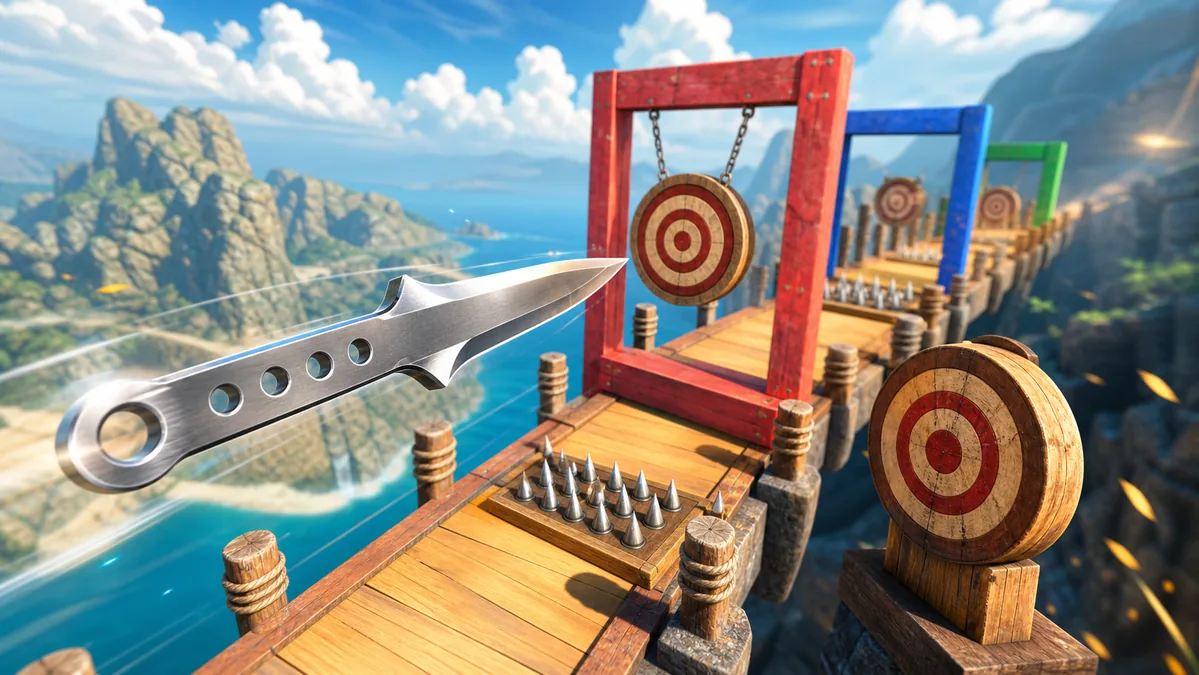
Knife Run Game turns a simple blade silhouette into a strong study of direction and timing. This article looks beyond the game-page description to examine how targets, lane boundaries, and changing distances can make a fast arcade scene readable while it remains in motion.
A Blade Creates a Natural Direction
The long shape of a knife points the eye forward before anything moves. Placing targets on the same visual axis strengthens that direction, while small changes in height prevent the route from appearing flat. Clear empty space around the blade also keeps its outline recognizable against a busy course.
Targets Need Consistent Visual Rules
Wood, paint, and metal can identify different surfaces without relying on labels. Repeated rings establish scale, and visible gaps show where one challenge ends and another begins. The original hero image is editorial artwork rather than a screenshot.
Details That Preserve Clarity
- Strong contrast around the blade edge.
- Targets aligned with the central route.
- Shadows that show distance from the surface.
- Color gates separated from the background.
Open the Game and Category
Knife Run Game opens on OviGames. It is listed in Adventure Games. More recent browser titles are available on the OviGames homepage.
Speed Is Visible Through Perspective
Objects becoming larger near the foreground suggest rapid approach. Motion streaks can reinforce that effect, but the most important elements must remain sharp enough to identify. A stable horizon gives the moving scene a reference point.
Final Perspective
A fast route remains understandable when shape, spacing, and perspective all point in the same direction. The blade supplies focus, the targets provide rhythm, and the course communicates distance.
Extended Visual Essay
A measured reading of Knife Run Game begins with the relationship described as A Blade Creates a Natural Direction. The composition can be read as a sequence of choices about emphasis, distance, and balance. The specific note “Color gates separated from the background” supplies an article-based reference, so the discussion can develop from material already established rather than from an invented feature. It remains an interpretation of the editorial presentation, not a claim about undocumented gameplay.
The visual argument around Knife Run Game becomes clearer when Targets Need Consistent Visual Rules is considered at a slower pace. The value of this detail lies in the way it organizes attention without relying on promotional claims. The specific note “Strong contrast around the blade edge” supplies an article-based reference, so the discussion can develop from material already established rather than from an invented feature. It remains an interpretation of the editorial presentation, not a claim about undocumented gameplay.
Within Knife Run Game, the idea of Details That Preserve Clarity deserves more than a quick glance. This observation connects the larger scene with the smaller reference points already identified in the article. The specific note “Targets aligned with the central route” supplies an article-based reference, so the discussion can develop from material already established rather than from an invented feature. It remains an interpretation of the editorial presentation, not a claim about undocumented gameplay.
A measured reading of Knife Run Game begins with the relationship described as Open the Game and Category. The composition can be read as a sequence of choices about emphasis, distance, and balance. The specific note “Shadows that show distance from the surface” supplies an article-based reference, so the discussion can develop from material already established rather than from an invented feature. It remains an interpretation of the editorial presentation, not a claim about undocumented gameplay.
The visual argument around Knife Run Game becomes clearer when Speed Is Visible Through Perspective is considered at a slower pace. The value of this detail lies in the way it organizes attention without relying on promotional claims. The specific note “Color gates separated from the background” supplies an article-based reference, so the discussion can develop from material already established rather than from an invented feature. It remains an interpretation of the editorial presentation, not a claim about undocumented gameplay.
Within Knife Run Game, the idea of Final Perspective deserves more than a quick glance. This observation connects the larger scene with the smaller reference points already identified in the article. The specific note “Strong contrast around the blade edge” supplies an article-based reference, so the discussion can develop from material already established rather than from an invented feature. It remains an interpretation of the editorial presentation, not a claim about undocumented gameplay.
A measured reading of Knife Run Game begins with the relationship described as A Blade Creates a Natural Direction. The composition can be read as a sequence of choices about emphasis, distance, and balance. The specific note “Targets aligned with the central route” supplies an article-based reference, so the discussion can develop from material already established rather than from an invented feature. It remains an interpretation of the editorial presentation, not a claim about undocumented gameplay.
The visual argument around Knife Run Game becomes clearer when Targets Need Consistent Visual Rules is considered at a slower pace. The value of this detail lies in the way it organizes attention without relying on promotional claims. The specific note “Shadows that show distance from the surface” supplies an article-based reference, so the discussion can develop from material already established rather than from an invented feature. It remains an interpretation of the editorial presentation, not a claim about undocumented gameplay.
Within Knife Run Game, the idea of Details That Preserve Clarity deserves more than a quick glance. This observation connects the larger scene with the smaller reference points already identified in the article. The specific note “Color gates separated from the background” supplies an article-based reference, so the discussion can develop from material already established rather than from an invented feature. It remains an interpretation of the editorial presentation, not a claim about undocumented gameplay.