Gun Thief Auto: Reading a Voxel City After Sunset
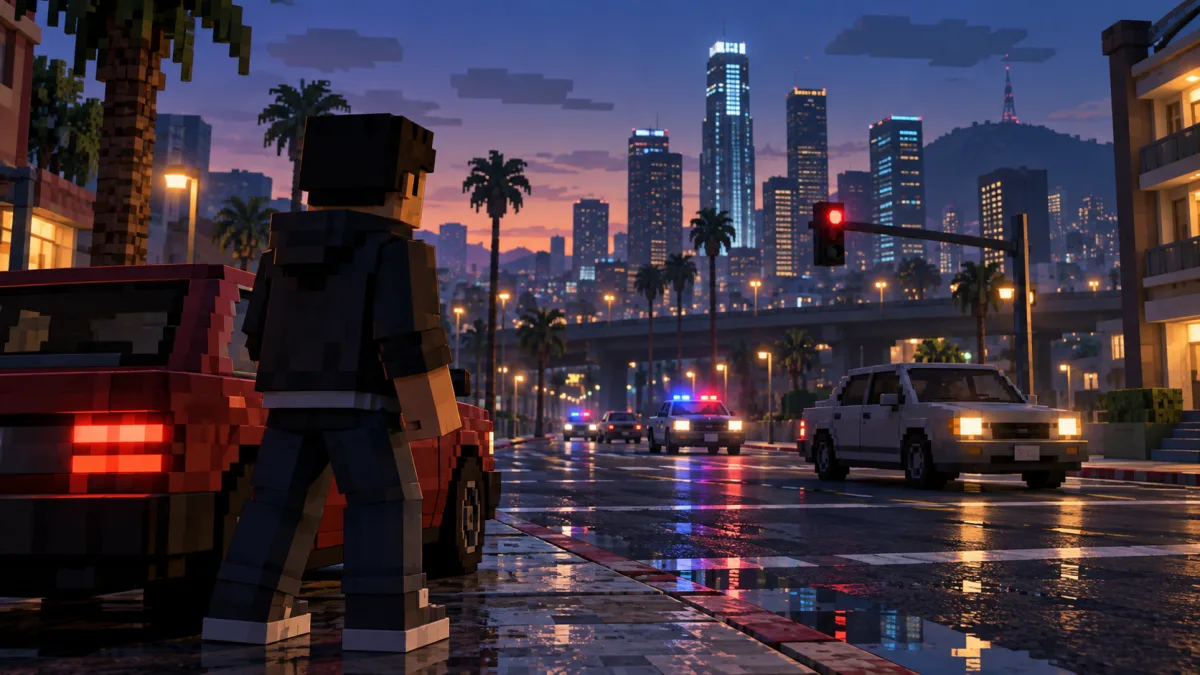
The original editorial image for Gun Thief Auto places an anonymous voxel figure beside a parked car as evening settles over a broad city intersection. Police lights remain distant, traffic crosses the wet road, and towers establish the scale of the urban grid. The composition is informed by the confirmed open-world city theme, vehicles, police attention, rooftops, and varied districts, but it does not reproduce the game interface or invent a specific mission.
The Street Establishes a Clear Direction
Long lane markings lead from the lower edge toward the illuminated skyline. Their perspective makes the road readable before the viewer studies individual vehicles. Reflections extend the lamps across the asphalt, creating parallel bands that reinforce depth while keeping the intersection visually open.
The central figure faces into this space instead of toward the viewer. That choice connects the person to the city and avoids turning the image into a character portrait. A red car anchors the near left corner, while a pale vehicle balances it across the road.
Distant Lights Suggest Pressure Without Showing Conflict
Blue and red lights appear several blocks away. They introduce the confirmed police-attention idea without depicting a chase, collision, weapon, or arrest. Distance matters here: the lights influence the atmosphere, yet the quiet foreground remains available for observation.
Wet pavement multiplies those colors without adding new objects. Reflections are therefore both decorative and structural. They separate lanes, echo the skyline, and guide attention toward the distant vehicles.
A Voxel City Can Still Feel Layered
Block-based forms simplify windows, palms, balconies, and car bodies, but changes in scale preserve complexity. Nearby surfaces show larger squares and harder edges; distant towers use smaller lights and softer silhouettes. The result suggests a large six-by-six urban grid without pretending to map its exact districts.
Visual Evidence Used
- Voxel architecture supports the published visual identity.
- Several vehicle types imply mobility without defining controls.
- Road, bridge, housing, and towers suggest distinct urban zones.
- Distant police lights reference the wanted system carefully.
- No logo, copied interface, readable text, or active violence appears.
Continue Through OviGames
Visit Gun Thief Auto for the playable page, browse Adventure Games, or return to the OviGames homepage.
Closing Observation
The image succeeds by withholding more than it explains. An open road, a watching figure, and distant signals create uncertainty while the city remains the primary subject. Geometry gives the scene order; color introduces tension; and the restrained foreground leaves interaction details where they belong—inside the game itself.
Architecture as a Navigation Language
Balconies, palms, stair edges, overpasses, and illuminated windows break the city into recognizable layers. Repetition makes the blocks feel related, while changes in height prevent the grid from becoming mechanical. A viewer can distinguish residential edges, a main traffic corridor, and a denser center without assigning official names to any district.
The skyline also acts as a visual clock. Cool blue towers belong to the approaching night, while orange lamps and sunset remain close to street level. This transition gives the scene a temporary quality: the city is neither fully active in daylight nor completely transformed by darkness.
Why the Foreground Remains Quiet
Keeping the nearby sidewalk free from crowds makes each cue more legible. The person, parked car, wet curb, and traffic signal can be compared without overlap. That quietness strengthens the distant pressure because the viewer has time to notice it.