Going Up Rooftop: How a City Becomes a Vertical Route
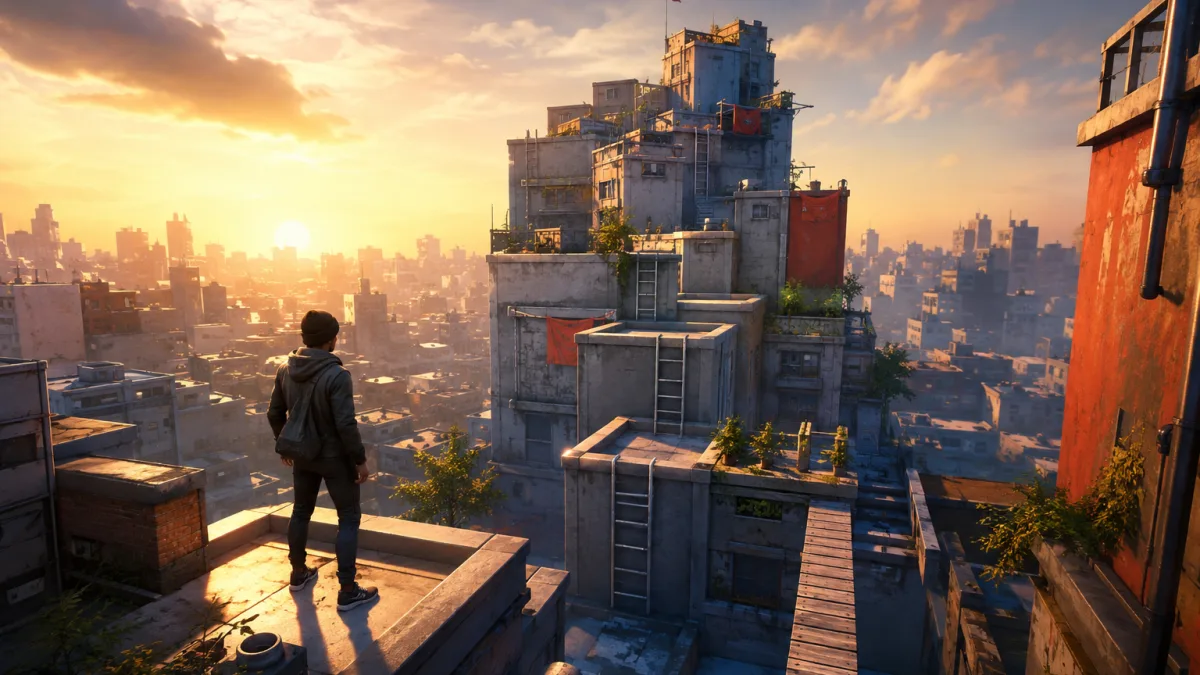
Going Up Rooftop turns an ordinary skyline into a sequence of possible directions. The editorial image does not describe undocumented controls or objectives; instead, it examines how architecture, height, and morning light can make a vertical route readable. Roofs that would normally feel separate become connected through ladders, ledges, bridges, and repeated changes in elevation.
The City Is Read From Near to Far
The nearest roof establishes the viewer’s position through a clear edge and a single anonymous figure. From there, the eye moves toward a taller central structure. Every intermediate platform is large enough to register as a separate landing area, while the distant skyline supplies scale without competing with the route.
Repetition Creates Continuity
Ladders recur at different heights and provide a consistent visual language. Wooden bridges introduce horizontal pauses between the upward movements. Red fabric panels repeat across the buildings, acting as landmarks that connect otherwise neutral concrete surfaces. These elements make the route coherent before any assumptions about gameplay are introduced.
Height Depends on Negative Space
Open sky and deep street canyons separate the structures. Without those empty regions, the stacked buildings would collapse into one dense shape. Atmospheric haze also reduces detail in the distance, keeping the nearest edges and the central tower dominant.
Morning Light Explains Form
Low sunlight strikes the upper faces of walls, steps, and roof borders. Long shadows clarify the thickness of platforms and the direction of each connection. Warm highlights contrast with cooler shaded façades, producing depth while preserving the legibility of the route.
Visual Notes
- Ladders establish a repeated upward rhythm.
- Bridges create short horizontal transitions.
- Red panels distinguish similar concrete levels.
- The figure provides scale without defining a character.
- Haze separates the active structure from the background city.
From Editorial Study to Game Page
See Going Up Rooftop, compare its theme with the Arcade Games category, or return to the OviGames homepage.
A Reflective Closing
The strongest part of the composition is not the height alone, but the way that height is organized. Repeated objects, clear silhouettes, and alternating vertical and horizontal lines turn a crowded city into an understandable sequence. The hero image is original editorial artwork rather than a gameplay screenshot.
Architecture as a Sequence of Decisions
A route across roofs is visually convincing only when each transition can be understood from the previous position. The central building therefore presents several kinds of connection: a ladder climbs one face, a short stair changes level, and a plank bridge crosses an open gap. Each device has a different silhouette, but all point toward the same higher structure. This creates variation without breaking continuity.
Materials Distinguish Safe Surfaces
Concrete, brick, timber, metal, and vegetation react differently to the sunrise. Concrete platforms hold broad pale highlights, brick edges remain warmer, and metal pipes produce thin reflections. Wooden bridges carry visible boards that clarify their direction. These material changes prevent adjacent surfaces from merging, particularly where several roofs overlap in perspective.
The Role of Small Details
Plants, pipes, railings, and fabric suggest that the buildings are occupied spaces rather than abstract blocks. They remain secondary because their scale is controlled and their colors repeat elsewhere in the frame. No single detail becomes an instruction; together they give the route a believable urban context.
Why the Horizon Remains Quiet
The distant city contains many buildings, yet haze compresses their windows and edges into soft texture. This restraint protects the central climb from visual competition. The sun is bright but positioned away from the main route, illuminating the scene without becoming its destination.
Viewed as a whole, the composition demonstrates how environmental design can communicate direction through ordinary architecture. Nothing requires a floating arrow when ladders, light, and height already establish a readable progression.
Orientation Without Labels
The image also demonstrates that orientation can emerge from relationships rather than written instructions. The figure faces the central structure, the bridges narrow toward it, and the tallest flag marks the upper region. These cues agree with one another, so the viewer does not need to decode competing signals. Their restraint is important: a city this detailed could easily become confusing if every roof demanded equal attention.