GapShot: How a Narrow Opening Sharpens Visual Focus
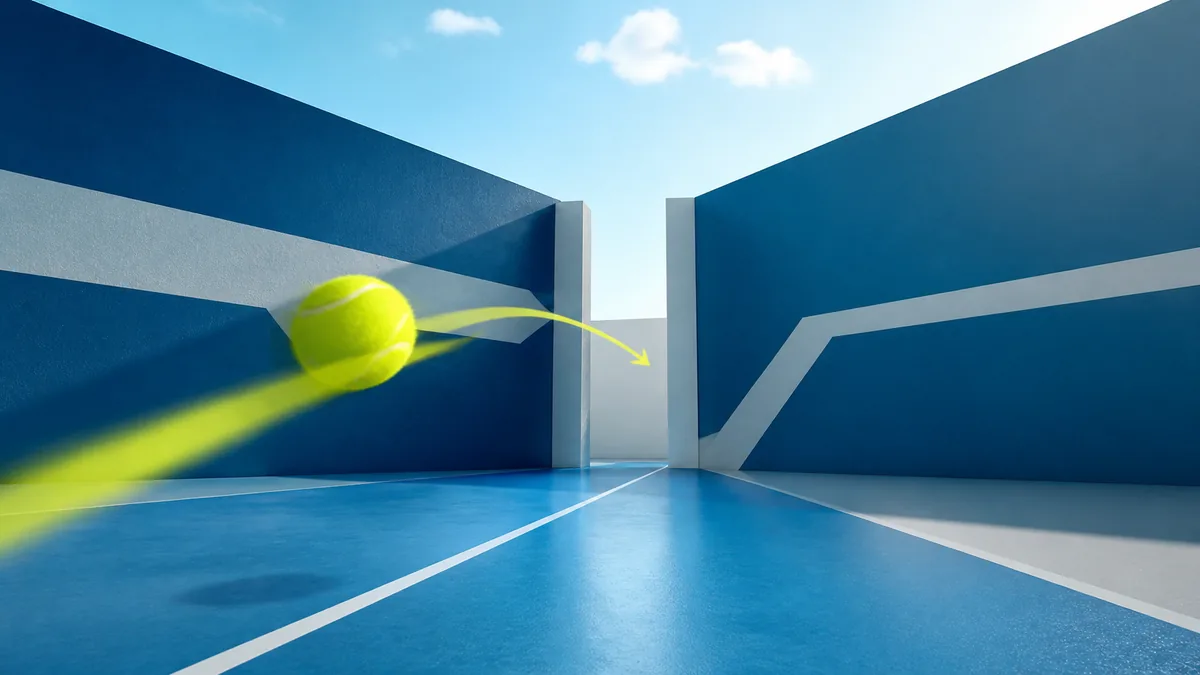
GapShot reduces a sports image to a particularly clear relationship: a moving ball, a restricted opening, and the space between them. This editorial article examines how geometry and contrast can make that relationship readable without repeating the game description or inventing scoring rules.
The Opening Becomes the Main Landmark
Two tall walls create a single break near the center of the composition. Their shared color and scale make the empty space more important than either wall. Court lines converge toward the same point, so architecture and surface markings communicate one direction.
A Visible Arc Explains Motion
The ball remains large enough to identify in the foreground, while a restrained trajectory leads toward the gap. Motion blur follows that path instead of covering the surrounding boundaries. The original hero image is editorial artwork, not a gameplay screenshot.
Details That Support the Composition
- Court lines reinforce alignment.
- Strong blue surfaces frame the target.
- Open sky separates the wall silhouettes.
- One ball preserves a clear focal hierarchy.
Visit GapShot
Open GapShot on Ovigames, browse the Sports Games category, or return to the homepage.
Closing View
Precision becomes understandable when the destination is unmistakable. A simple opening, controlled perspective, and a clean movement arc create tension without requiring excessive interface detail.
Extended Visual Essay
Within GapShot, the idea of The Opening Becomes the Main Landmark deserves more than a quick glance. The value of this detail lies in the way it organizes attention without relying on promotional claims. The specific note “Court lines reinforce alignment” supplies an article-based reference, so the discussion can develop from material already established rather than from an invented feature. Seen in this context, the detail supports the article’s argument without adding unverified mechanics.
A measured reading of GapShot begins with the relationship described as A Visible Arc Explains Motion. This observation connects the larger scene with the smaller reference points already identified in the article. The specific note “Strong blue surfaces frame the target” supplies an article-based reference, so the discussion can develop from material already established rather than from an invented feature. Seen in this context, the detail supports the article’s argument without adding unverified mechanics.
The visual argument around GapShot becomes clearer when Details That Support the Composition is considered at a slower pace. The composition can be read as a sequence of choices about emphasis, distance, and balance. The specific note “Open sky separates the wall silhouettes” supplies an article-based reference, so the discussion can develop from material already established rather than from an invented feature. Seen in this context, the detail supports the article’s argument without adding unverified mechanics.
Within GapShot, the idea of Visit GapShot deserves more than a quick glance. The value of this detail lies in the way it organizes attention without relying on promotional claims. The specific note “One ball preserves a clear focal hierarchy” supplies an article-based reference, so the discussion can develop from material already established rather than from an invented feature. Seen in this context, the detail supports the article’s argument without adding unverified mechanics.
A measured reading of GapShot begins with the relationship described as Closing View. This observation connects the larger scene with the smaller reference points already identified in the article. The specific note “Court lines reinforce alignment” supplies an article-based reference, so the discussion can develop from material already established rather than from an invented feature. Seen in this context, the detail supports the article’s argument without adding unverified mechanics.
The visual argument around GapShot becomes clearer when The Opening Becomes the Main Landmark is considered at a slower pace. The composition can be read as a sequence of choices about emphasis, distance, and balance. The specific note “Strong blue surfaces frame the target” supplies an article-based reference, so the discussion can develop from material already established rather than from an invented feature. Seen in this context, the detail supports the article’s argument without adding unverified mechanics.
Within GapShot, the idea of A Visible Arc Explains Motion deserves more than a quick glance. The value of this detail lies in the way it organizes attention without relying on promotional claims. The specific note “Open sky separates the wall silhouettes” supplies an article-based reference, so the discussion can develop from material already established rather than from an invented feature. Seen in this context, the detail supports the article’s argument without adding unverified mechanics.
A measured reading of GapShot begins with the relationship described as Details That Support the Composition. This observation connects the larger scene with the smaller reference points already identified in the article. The specific note “One ball preserves a clear focal hierarchy” supplies an article-based reference, so the discussion can develop from material already established rather than from an invented feature. Seen in this context, the detail supports the article’s argument without adding unverified mechanics.
The visual argument around GapShot becomes clearer when Visit GapShot is considered at a slower pace. The composition can be read as a sequence of choices about emphasis, distance, and balance. The specific note “Court lines reinforce alignment” supplies an article-based reference, so the discussion can develop from material already established rather than from an invented feature. Seen in this context, the detail supports the article’s argument without adding unverified mechanics.
Within GapShot, the idea of Closing View deserves more than a quick glance. The value of this detail lies in the way it organizes attention without relying on promotional claims. The specific note “Strong blue surfaces frame the target” supplies an article-based reference, so the discussion can develop from material already established rather than from an invented feature. Seen in this context, the detail supports the article’s argument without adding unverified mechanics.