Ember Boy and Ripple Girl: Designing Contrast Between Fire and Water
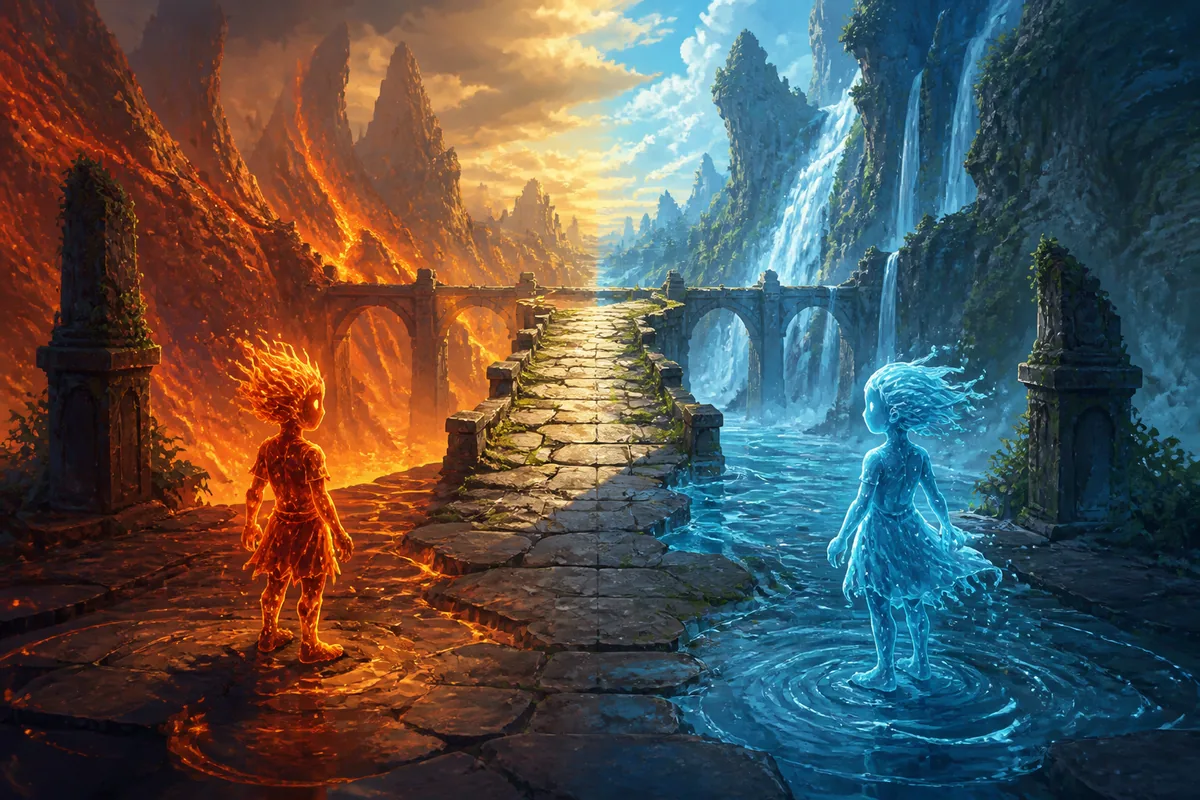
Ember Boy and Ripple Girl builds its identity around two natural forces that are easy to recognize yet difficult to place in the same scene. This editorial study considers how fire and water can share one composition without losing their separate personalities. It does not repeat the game description; instead, it looks at color, light, silhouette, and environmental balance.
Two Palettes Establish Two Characters
Warm oranges and deep reds make Ember Boy readable against dark stone, while clear blues and pale cyan separate Ripple Girl from the cooler half of the landscape. Their contrasting glows create a visual conversation across the bridge. Neither side needs labels because temperature and color already communicate the difference.
The Bridge Becomes Neutral Ground
A weathered stone path connects the volcanic and waterfall regions. Its muted gray surface prevents either palette from dominating the center, and its repeated arches guide attention from one side to the other. The original hero image is editorial artwork, not a gameplay screenshot.
Why Balance Matters
An elemental composition works best when difference does not become visual conflict. Similar character scale and matching placement create unity, while the opposing landscapes retain the theme of contrast. This balance makes the scene understandable on both wide and narrow screens.
Details That Preserve the Contrast
- Orange reflections remain near the fire side.
- Blue mist softens the water side.
- The central path uses restrained, neutral tones.
- Both figures have equally clear silhouettes.
Explore the Adventure
Open Ember Boy and Ripple Girl on OviGames, browse the Adventure Games category, or return to the OviGames homepage for recent additions.
Closing View
Fire and water remain distinct through color, texture, and light, while the shared bridge ties the composition together. The result is a clear elemental world built from opposition and visual harmony.
Extended Visual Essay
Within Ember Boy and Ripple Girl, the idea of Two Palettes Establish Two Characters deserves more than a quick glance. The value of this detail lies in the way it organizes attention without relying on promotional claims. The specific note “Blue mist softens the water side” supplies an article-based reference, so the discussion can develop from material already established rather than from an invented feature. Seen in this context, the detail supports the article’s argument without adding unverified mechanics.
A measured reading of Ember Boy and Ripple Girl begins with the relationship described as The Bridge Becomes Neutral Ground. This observation connects the larger scene with the smaller reference points already identified in the article. The specific note “The central path uses restrained, neutral tones” supplies an article-based reference, so the discussion can develop from material already established rather than from an invented feature. Seen in this context, the detail supports the article’s argument without adding unverified mechanics.
The visual argument around Ember Boy and Ripple Girl becomes clearer when Why Balance Matters is considered at a slower pace. The composition can be read as a sequence of choices about emphasis, distance, and balance. The specific note “Both figures have equally clear silhouettes” supplies an article-based reference, so the discussion can develop from material already established rather than from an invented feature. Seen in this context, the detail supports the article’s argument without adding unverified mechanics.
Within Ember Boy and Ripple Girl, the idea of Details That Preserve the Contrast deserves more than a quick glance. The value of this detail lies in the way it organizes attention without relying on promotional claims. The specific note “Orange reflections remain near the fire side” supplies an article-based reference, so the discussion can develop from material already established rather than from an invented feature. Seen in this context, the detail supports the article’s argument without adding unverified mechanics.
A measured reading of Ember Boy and Ripple Girl begins with the relationship described as Explore the Adventure. This observation connects the larger scene with the smaller reference points already identified in the article. The specific note “Blue mist softens the water side” supplies an article-based reference, so the discussion can develop from material already established rather than from an invented feature. Seen in this context, the detail supports the article’s argument without adding unverified mechanics.
The visual argument around Ember Boy and Ripple Girl becomes clearer when Closing View is considered at a slower pace. The composition can be read as a sequence of choices about emphasis, distance, and balance. The specific note “The central path uses restrained, neutral tones” supplies an article-based reference, so the discussion can develop from material already established rather than from an invented feature. Seen in this context, the detail supports the article’s argument without adding unverified mechanics.
Within Ember Boy and Ripple Girl, the idea of Two Palettes Establish Two Characters deserves more than a quick glance. The value of this detail lies in the way it organizes attention without relying on promotional claims. The specific note “Both figures have equally clear silhouettes” supplies an article-based reference, so the discussion can develop from material already established rather than from an invented feature. Seen in this context, the detail supports the article’s argument without adding unverified mechanics.
A measured reading of Ember Boy and Ripple Girl begins with the relationship described as The Bridge Becomes Neutral Ground. This observation connects the larger scene with the smaller reference points already identified in the article. The specific note “Orange reflections remain near the fire side” supplies an article-based reference, so the discussion can develop from material already established rather than from an invented feature. Seen in this context, the detail supports the article’s argument without adding unverified mechanics.