Drunk Basket: Balance, Motion, and the Crooked Arc
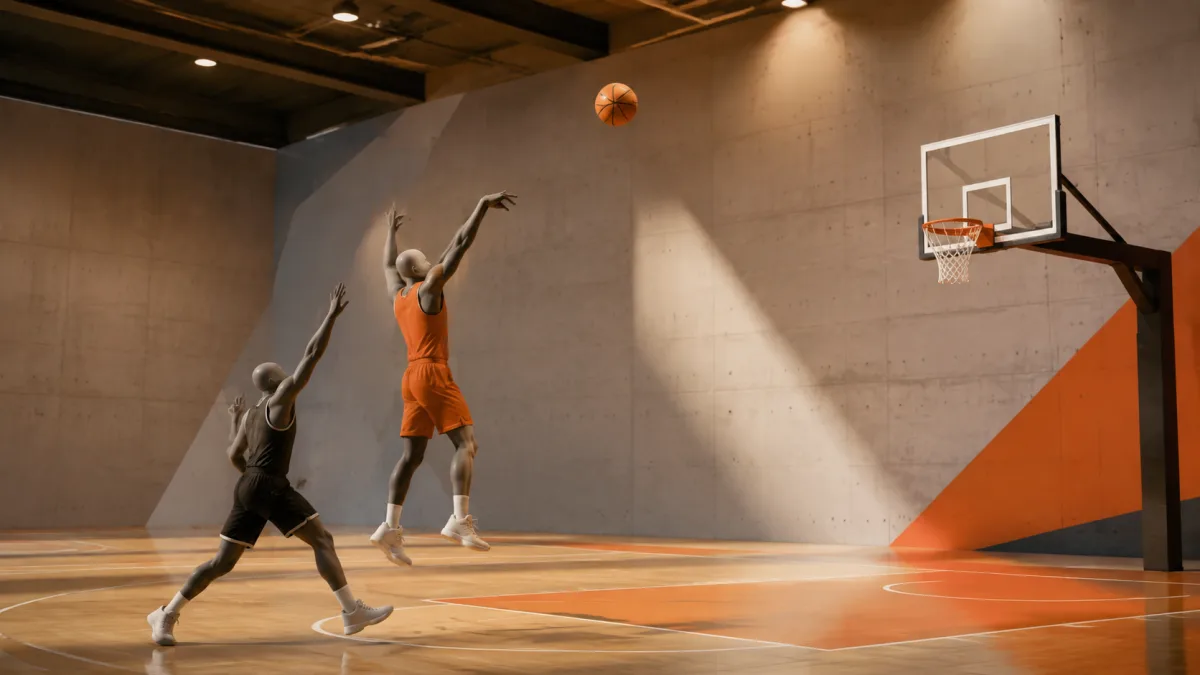
Drunk Basket is approached here as a study in unstable motion. Two anonymous athletes, a suspended ball, and a single hoop are enough to turn a familiar court into an image about balance. The editorial illustration avoids pretending to document a particular match or control system. Instead, it asks how posture, trajectory, and empty space can make an intentionally awkward basketball scene legible.
The Court Begins With a Tilt
The nearest figure leans away from a conventional athletic stance. Bent limbs and an uneven center of gravity immediately change the tone: precision is present, but it must coexist with imbalance. The second figure answers that posture from the opposite side of the frame, producing a visual conversation rather than a static portrait.
The Ball Connects Separate Shapes
A basketball occupies relatively little space, yet it controls the direction of the image. Its position between player and hoop creates an implied arc. That invisible curve links the broad human silhouettes to the rigid rectangle of the backboard. The eye completes the movement without requiring arrows, speed lines, or a crowded interface.
Negative Space Makes Timing Visible
The open area around the ball is not wasted room. It isolates the decisive object and makes its distance from the hoop measurable. Court markings reinforce that reading by supplying fixed references below. When bodies appear unstable, the geometry of the floor becomes the dependable layer against which their movement can be judged.
Warm Light Holds the Scene Together
Amber arena light gives the floor, skin, and ball a related warmth, while cooler shadows separate limbs from the background. This controlled palette prevents the comic posture from becoming visual noise. Highlights remain concentrated on the ball and upper edges of the figures, preserving a clear hierarchy.
Visual Notes
- The hoop is positioned as a precise architectural counterweight.
- Uneven poses establish humor without facial caricature.
- Court lines provide stable measurements beneath unstable bodies.
- The airborne ball forms the central directional bridge.
- The image is original editorial artwork, not a gameplay screenshot.
Reading the Sports Context
The confirmed theme is basketball, so the scene stays with recognizable equipment and court space. It does not add a tournament, named athletes, special abilities, or undocumented scoring conditions. That restraint matters: an editorial article can examine visual character without turning inference into fact.
Continue From Image to Page
Open Drunk Basket, compare its setting with the Sports Games category, or return to the OviGames homepage.
A Reflective Closing
The composition succeeds because instability is never confused with disorder. The players may lean, the ball may hang between outcomes, and the moment may look comic, but the hoop, floor, and lighting maintain a dependable structure. That tension between a crooked body and a readable arc gives the scene its identity.
Posture as a Graphic System
Each body can be reduced to a sequence of diagonals. Shoulders turn one way, legs answer in another direction, and arms extend toward the ball. Those broken lines communicate instability more effectively than an exaggerated expression would. They also create variety against the straight backboard and horizontal floor. The rigid court architecture therefore does more than describe a location: it gives every uneven posture a reference against which it can be understood.
Why the Frame Avoids a Crowd
Additional spectators or players might make the arena feel larger, but they would weaken the specific relationship among ball, athletes, and hoop. By limiting the cast, the composition treats each gap as useful information. The viewer can compare distance, orientation, and scale without searching through unrelated figures. This restraint is especially important for a wide hero that must also remain readable as a small article card.
Editorial Restraint and Game Identity
A title can suggest a humorous physical style, yet it does not prove how every movement behaves. The article therefore distinguishes visible interpretation from confirmed information. Basketball equipment, an unstable pose, and an interrupted arc are appropriate editorial subjects; precise controls, scoring variations, and match structure belong to the game page itself. Keeping that boundary clear makes the visual essay informative without turning decorative artwork into evidence.