Crazy Car Drive Road Challenge: Reading a Mountain Road Before the Turn
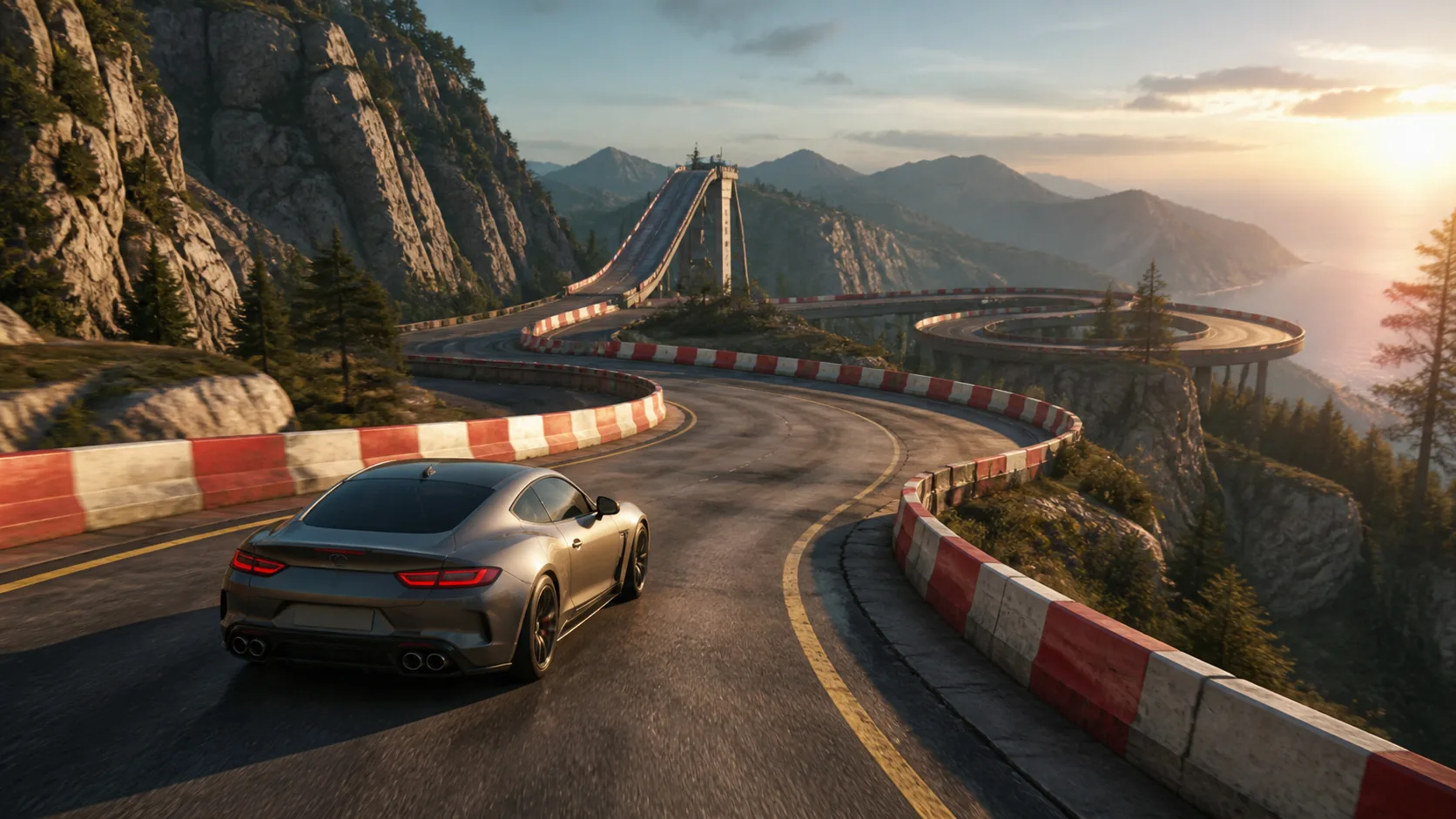
Crazy Car Drive Road Challenge places the road itself at the center of its visual identity. This essay studies how bends, barriers, elevation, and late-afternoon light can turn a mountain route into a readable composition without inventing objectives, controls, or progression.
The Road Is a Continuous Visual Argument
A broad foreground curve introduces direction before the vehicle becomes important. Repeating red-and-white barriers trace every change in the route, while the distant ramp explains that the road continues beyond the first bend. The composition therefore works as a chain of connected landmarks rather than a single dramatic corner.
Elevation Changes the Meaning of Distance
Cliffs, sea, and layered mountain ridges give the roadway a measurable scale. Sections that overlap remain distinguishable because each sits at a different height. Atmospheric haze softens the farthest structures, allowing the nearer asphalt and barrier edges to retain stronger contrast.
Light Describes Surface and Direction
Warm sunlight travels across the road at a low angle, revealing small changes in texture without hiding the lane. The vehicle receives a narrow highlight along its roof and rear bodywork. Shadows fall away from the intended direction of travel, helping the eye follow the course toward the brighter horizon.
Visual Notes
- Repeated barriers connect separated road sections.
- Wide curves remain legible against darker rock.
- The car occupies only one part of the larger landscape.
- Warm and cool regions separate foreground from distance.
Continue From the Editorial View
Open Crazy Car Drive Road Challenge, explore the Racing Games category, or return to the OviGames homepage.
A Reflective Closing
The scene succeeds because every dramatic element still serves orientation. Height supplies spectacle, but edges, repeated colors, and perspective keep the roadway understandable. The original hero illustration is editorial artwork rather than a gameplay screenshot.
Extended Visual Essay
A measured reading of Crazy Car Drive Road Challenge begins with the relationship described as The Road Is a Continuous Visual Argument. The composition can be read as a sequence of choices about emphasis, distance, and balance. The specific note “Wide curves remain legible against darker rock” supplies an article-based reference, so the discussion can develop from material already established rather than from an invented feature. It remains an interpretation of the editorial presentation, not a claim about undocumented gameplay.
The visual argument around Crazy Car Drive Road Challenge becomes clearer when Elevation Changes the Meaning of Distance is considered at a slower pace. The value of this detail lies in the way it organizes attention without relying on promotional claims. The specific note “The car occupies only one part of the larger landscape” supplies an article-based reference, so the discussion can develop from material already established rather than from an invented feature. It remains an interpretation of the editorial presentation, not a claim about undocumented gameplay.
Within Crazy Car Drive Road Challenge, the idea of Light Describes Surface and Direction deserves more than a quick glance. This observation connects the larger scene with the smaller reference points already identified in the article. The specific note “Warm and cool regions separate foreground from distance” supplies an article-based reference, so the discussion can develop from material already established rather than from an invented feature. It remains an interpretation of the editorial presentation, not a claim about undocumented gameplay.
A measured reading of Crazy Car Drive Road Challenge begins with the relationship described as Visual Notes. The composition can be read as a sequence of choices about emphasis, distance, and balance. The specific note “Repeated barriers connect separated road sections” supplies an article-based reference, so the discussion can develop from material already established rather than from an invented feature. It remains an interpretation of the editorial presentation, not a claim about undocumented gameplay.
The visual argument around Crazy Car Drive Road Challenge becomes clearer when Continue From the Editorial View is considered at a slower pace. The value of this detail lies in the way it organizes attention without relying on promotional claims. The specific note “Wide curves remain legible against darker rock” supplies an article-based reference, so the discussion can develop from material already established rather than from an invented feature. It remains an interpretation of the editorial presentation, not a claim about undocumented gameplay.
Within Crazy Car Drive Road Challenge, the idea of A Reflective Closing deserves more than a quick glance. This observation connects the larger scene with the smaller reference points already identified in the article. The specific note “The car occupies only one part of the larger landscape” supplies an article-based reference, so the discussion can develop from material already established rather than from an invented feature. It remains an interpretation of the editorial presentation, not a claim about undocumented gameplay.
A measured reading of Crazy Car Drive Road Challenge begins with the relationship described as The Road Is a Continuous Visual Argument. The composition can be read as a sequence of choices about emphasis, distance, and balance. The specific note “Warm and cool regions separate foreground from distance” supplies an article-based reference, so the discussion can develop from material already established rather than from an invented feature. It remains an interpretation of the editorial presentation, not a claim about undocumented gameplay.
The visual argument around Crazy Car Drive Road Challenge becomes clearer when Elevation Changes the Meaning of Distance is considered at a slower pace. The value of this detail lies in the way it organizes attention without relying on promotional claims. The specific note “Repeated barriers connect separated road sections” supplies an article-based reference, so the discussion can develop from material already established rather than from an invented feature. It remains an interpretation of the editorial presentation, not a claim about undocumented gameplay.