Car Parking Master 3D: Reading Space, Angle and Control
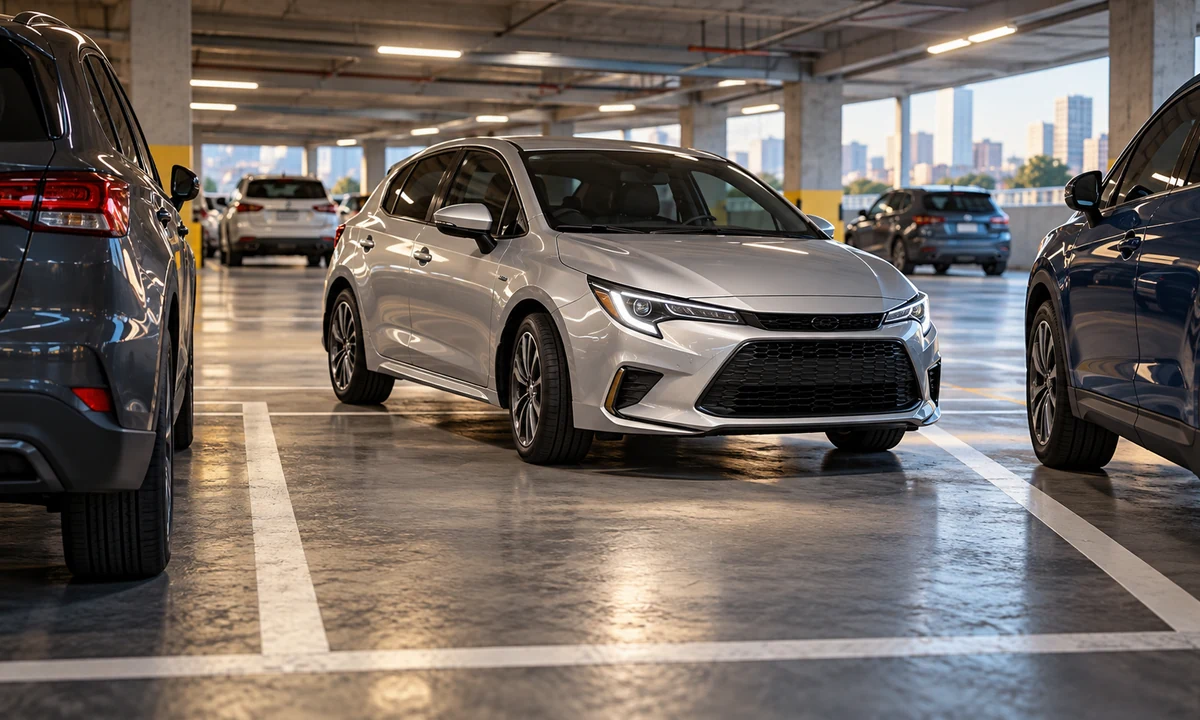
Car Parking Master 3D turns tight parking spaces into a focused test of approach angle, clearance, and careful correction across different vehicle types. The listing describes a browser driving game with signs, obstacles, and varied parking situations.
The useful question for a parking game is not simply whether a car can move. It is whether the space around it can be read clearly enough to make each move intentional. The current game description points to levels, signs, obstacles, and tight spots. Those elements put attention on approach and positioning: players need to notice the available route, judge the room left beside the vehicle, and correct course before a small error becomes a larger one.
Space is the main puzzle
Parking turns a familiar vehicle into a tool for solving a compact spatial problem. A wide open road leaves many possible directions; a marked bay narrows those choices. That change in scale is what makes a parking level distinct. The task becomes one of aligning the car with a target while keeping nearby boundaries in view. The description for this title specifically mentions navigating cars through environments, following signs, and avoiding obstacles. It does not name every level or obstacle, so the analysis stays with the decisions those listed elements imply.
Signs can provide orientation before the player reaches the difficult part of a route. Obstacles do the opposite: they make the usable space more specific. Together, these details give a level a readable structure. The player can scan ahead, choose an approach, and then make fine corrections as the available angle changes. A good parking challenge does not need a complicated rule set to create tension. It can ask for a familiar maneuver in a space where precision matters.
Vehicles change the scale of a maneuver
The site description names supercars and cargo vehicles among the available vehicle types. That distinction matters because a parking space is experienced in relation to the vehicle occupying it. A larger vehicle naturally asks the player to pay closer attention to clearance and turning room; a smaller one can make the same marked area feel more forgiving. This is a general reading of vehicle dimensions, not a claim about hidden handling statistics or a specific vehicle roster beyond the types the page names.
Multiple settings and vehicles are also listed, giving the game room to vary how a parking task is framed. The same basic aim can feel different when the surrounding layout changes. A broad approach can invite a smoother turn, while a narrower lane asks for more deliberate positioning. Variety is most useful when it changes the decision the player is making rather than simply changing the background. The page describes diverse environments and vehicles, but the exact sequence should be discovered in the game itself.
What the interface needs to communicate
Precision depends on feedback. The description calls the controls smooth and easy, and says players can focus on tight spots and tricky scenarios. For that promise to work, steering response and the car’s relation to the parking markers must remain legible. A player should be able to connect an input with the resulting movement, then make a correction without losing track of the target. The more confined the space, the more important it is that the camera and vehicle outline help show distance.
This is why a parking game is often at its best when it lets the player slow down mentally. The challenge is not necessarily speed. It is managing an approach with enough care to leave room for the final alignment. If a level includes an obstacle, that obstacle becomes a reference point as well as a hazard: it helps define which path remains open. Each turn can be treated as a small test of observation before it becomes a test of control.
Visual notes
- Marked spaces establish a clear destination for each parking task.
- Signs help frame the route through a level.
- Obstacles make clearance and approach angle part of the decision.
- Different vehicle types can change how a familiar space is read.
Find the game
Explore more titles in the Boys Games category or return to the OviGames homepage to browse the wider collection.
Car parking works as a quiet design exercise: it gives the player a destination, a vehicle, and a limited amount of space, then asks for care in the path between them. The appeal of this format comes from seeing a difficult angle become manageable through observation and measured corrections.