Car Driving School Game: Reading a Training Course
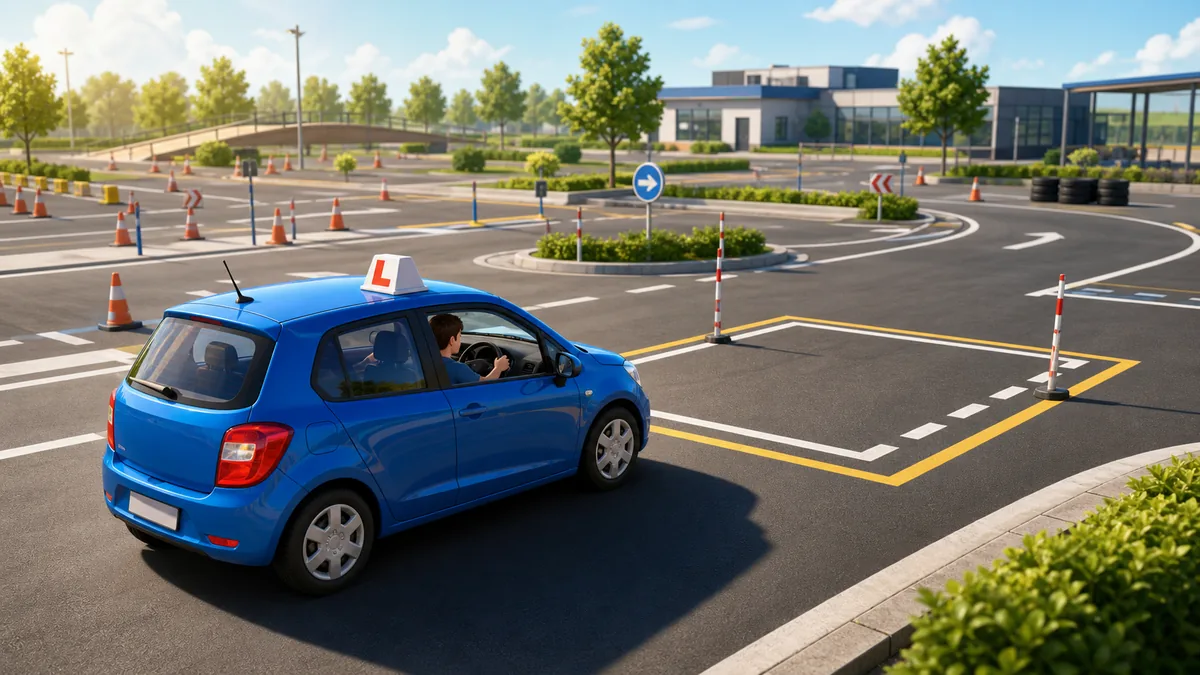
Car Driving School Game places road markings, cones, and vehicle position at the center of a structured practice environment. Rather than repeating the game-page description, this article studies the visual information that makes a training course understandable before the car begins to move.
Road Paint Creates a Shared Language
White boundaries, yellow parking outlines, and directional arrows divide the asphalt into readable zones. Their value is consistency: the same width and contrast should mean the same thing across the course. When markings remain visible beyond the car, direction and available space are easier to compare.
Cones Turn Empty Ground Into a Route
A broad paved area can feel ambiguous until temporary markers define its limits. Cones create gates, corners, and narrow passages without hiding the surface below. Their warm color also separates them from cool asphalt and green landscaping. The hero artwork is an original editorial illustration, not a screenshot.
References That Support Spatial Judgment
- The distance between the vehicle and painted edges.
- The angle of the car relative to a parking bay.
- Open space before and behind the body.
- Repeated markers that reveal the intended route.
Open the Game and Racing Category
Play Car Driving School Game on OviGames. The title is organized in Racing Games, while the OviGames homepage presents other recent browser releases.
A Raised View Clarifies Proportion
A slightly elevated camera can show the roof, wheels, and surrounding road in one frame. This perspective reduces uncertainty around corners while keeping the vehicle recognizable. Buildings and trees provide scale, but restrained detail prevents the background from competing with the practice area.
Final Observation
A convincing driving school depends on stable visual references. Road paint explains boundaries, cones explain temporary routes, and a clear camera angle connects the car to both.
Extended Visual Essay
A measured reading of Car Driving School Game begins with the relationship described as Road Paint Creates a Shared Language. The composition can be read as a sequence of choices about emphasis, distance, and balance. The specific note “The distance between the vehicle and painted edges” supplies an article-based reference, so the discussion can develop from material already established rather than from an invented feature. It remains an interpretation of the editorial presentation, not a claim about undocumented gameplay.
The visual argument around Car Driving School Game becomes clearer when Cones Turn Empty Ground Into a Route is considered at a slower pace. The value of this detail lies in the way it organizes attention without relying on promotional claims. The specific note “The angle of the car relative to a parking bay” supplies an article-based reference, so the discussion can develop from material already established rather than from an invented feature. It remains an interpretation of the editorial presentation, not a claim about undocumented gameplay.
Within Car Driving School Game, the idea of References That Support Spatial Judgment deserves more than a quick glance. This observation connects the larger scene with the smaller reference points already identified in the article. The specific note “Open space before and behind the body” supplies an article-based reference, so the discussion can develop from material already established rather than from an invented feature. It remains an interpretation of the editorial presentation, not a claim about undocumented gameplay.
A measured reading of Car Driving School Game begins with the relationship described as Open the Game and Racing Category. The composition can be read as a sequence of choices about emphasis, distance, and balance. The specific note “Repeated markers that reveal the intended route” supplies an article-based reference, so the discussion can develop from material already established rather than from an invented feature. It remains an interpretation of the editorial presentation, not a claim about undocumented gameplay.
The visual argument around Car Driving School Game becomes clearer when A Raised View Clarifies Proportion is considered at a slower pace. The value of this detail lies in the way it organizes attention without relying on promotional claims. The specific note “The distance between the vehicle and painted edges” supplies an article-based reference, so the discussion can develop from material already established rather than from an invented feature. It remains an interpretation of the editorial presentation, not a claim about undocumented gameplay.
Within Car Driving School Game, the idea of Final Observation deserves more than a quick glance. This observation connects the larger scene with the smaller reference points already identified in the article. The specific note “The angle of the car relative to a parking bay” supplies an article-based reference, so the discussion can develop from material already established rather than from an invented feature. It remains an interpretation of the editorial presentation, not a claim about undocumented gameplay.
A measured reading of Car Driving School Game begins with the relationship described as Road Paint Creates a Shared Language. The composition can be read as a sequence of choices about emphasis, distance, and balance. The specific note “Open space before and behind the body” supplies an article-based reference, so the discussion can develop from material already established rather than from an invented feature. It remains an interpretation of the editorial presentation, not a claim about undocumented gameplay.
The visual argument around Car Driving School Game becomes clearer when Cones Turn Empty Ground Into a Route is considered at a slower pace. The value of this detail lies in the way it organizes attention without relying on promotional claims. The specific note “Repeated markers that reveal the intended route” supplies an article-based reference, so the discussion can develop from material already established rather than from an invented feature. It remains an interpretation of the editorial presentation, not a claim about undocumented gameplay.