Ball Packing Master Puzzle: Color, Order, and Containers
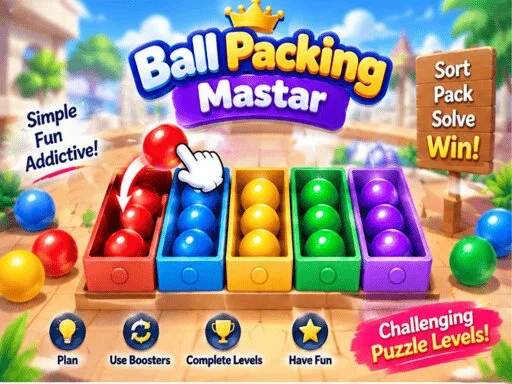
Ball Packing Master Puzzle – Fill Box turns a collection of colored balls and matching containers into a study of order. The supplier describes sorting balls into the correct boxes, planning moves, and using optional boosters. That is enough to establish the puzzle’s central relationship without inventing a board size, level count, or scoring formula. This visual essay looks at how color, position, and available space can make a sorting task readable from one move to the next.
Color supplies the first instruction
A sorting puzzle becomes understandable when related objects can be recognized before any movement begins. Distinct colors give the balls an immediate identity, while matching boxes provide destinations. The screen must preserve that relationship even when several objects occupy the same area. Clear separation matters more than decorative intensity: if neighboring colors blend, the logic of the task becomes harder to read.
Repeated round forms also create rhythm. A single ball is simple, but a group can become visually dense. Spacing and outline contrast allow the viewer to count positions and compare options without assuming which move the game will accept. The live interface remains the reference for legal placement.
Containers turn movement into organization
A box is not merely an endpoint. Its location gives the puzzle structure by dividing the board into regions with different purposes. Empty space inside a container can signal capacity, while balls already placed there show how the arrangement has changed. The supplier says the correct boxes must be filled; it does not define their capacity or whether every level uses the same layout.
This distinction keeps the article accurate. A viewer can observe the relationship between loose objects and containers without being promised a specific mechanic. The game itself should show whether a ball can move directly, whether intermediate positions matter, and when a box is considered complete.
Planning before action
The supplier explicitly mentions planning moves. In visual terms, planning means comparing the current arrangement with the remaining destinations. A move that solves one color may alter the space available for another. The useful question is therefore not only “where does this ball belong?” but also “what will the board look like afterward?”
Optional boosters are also named, although their effects are not described in the source. They should be treated as tools explained by the active game rather than shortcuts whose behavior can be guessed. The underlying puzzle should remain understandable even when a booster is available.
Visual notes
- Identify matching ball and box colors before moving anything.
- Use open spaces to compare possible arrangements.
- Check the resulting layout after each confirmed move.
- Read booster effects from the live interface.
- Do not assume that every level uses the same capacity or pattern.
Another useful visual test is to pause after a placement and scan the whole arrangement rather than following only the ball that just moved. A successful local match may still leave an awkward distribution elsewhere. This wider view helps separate the immediate satisfaction of matching a color from the larger task of organizing every visible container.
From analysis to the live puzzle
Open Ball Packing Master Puzzle – Fill Box for the current rules and controls. The Puzzle Games category offers a broader route through sorting and logic titles on the site.
A compact system of visible relationships
The game’s strongest confirmed idea is not a promotional promise of endless challenge. It is the direct connection among colored objects, matching containers, and the order in which decisions are made. Color explains identity, boxes establish structure, and planning connects the present board with the next one.
That combination can produce variety without requiring a complicated story. A new arrangement changes which matches are obvious and which spaces deserve attention. As long as the screen keeps colors and boundaries distinct, the puzzle can remain approachable while still asking for careful comparison. Ball Packing Master Puzzle – Fill Box is therefore best introduced as a visual organization problem whose precise rules should be learned from the running game.